

“…I am the work. I cannot separate the form of beauty and the form of expression, because every form I create is myself. The idea lives in me, and I transplant it into my works…”[i]
– Emmy Roth, Excerpt from New Women’s Clothing and Women’s Culture, 1926/1927.
Emmy Roth was “one of the most significant German silversmiths of the early twentieth century.”[ii] In the beginning she created small accessories and jewelry made of silver and semi-precious stones and perhaps carved ivory, but as she evolved as an artist, her repertoire expanded to include decorative household objects, Jewish ceremonial pieces, and modern tea and coffee services. There is an “elegant simplicity” to these innovative designs and admirers of Roth’s work often underscore the high level of craftsmanship, and her “fine sense of material.”[iii] However, a 1934 publication appears to best sum up the prevalent reaction to Roth’s creations. It plainly states that she produced “well-balanced silver utilitarian objects that make you feel good.”[iv]
Roth, who was Jewish, was one of the millions of people whose lives were dismantled by the rise of the National Socialists. In 1933, after the Nazi party assumed power in Germany, she left the country. Initially Roth moved to France, but as the threat of war intensified, she relocated to Palestine. There would be a brief return to Europe around 1937 to design for the Dutch silverware factory Van Kempen & Begeer, but ultimately she was forced back to Palestine.[v] In 1942, after receiving a cancer diagnosis, she took her own life. Her obituary reveals that in the end she not only felt “cut off by the war,” but her illness had forced her to quit working which was “her purpose in life.”[vi] Following Roth’s death, her contributions in metal seemed to have been pretty much forgotten.[vii] Fortunately, some recent scholarship has revealed her tremendous talent and perhaps she will now receive the credit she deserves.
PIONEER
Many details of Roth’s training as a silversmith have been lost to time. However, it is evident that this was an individual determined to pursue a career in metalwork, a male dominated discipline. Like her contemporary Paula Straus, she chose not to follow a traditional path in the more “feminine” practices of textiles or even bookbinding.[viii] Instead, Roth trained in various workshops and completed a “grueling” apprenticeship with Paul Beumers at the firm of Conrad Anton Beumers in Düsseldorf, Germany.[ix] Then, around 1907, Roth appears to have gone out on her own.[x] Freelancing would have been a challenge for anyone, male or female, at that time, but she overcame the odds and built a “large clientele, primarily from the culturally interested, wealthy middle class.”[xi] Eventually Roth had a workshop in the Charlottenburg district of Berlin and in the 7th arrondissement in Paris after her departure from Germany. Roth’s talents were also utilized by silverware factories such as Bruckmann & Söhne.[xii] These objects, which were made for mass production, first reflected the spirit of the Art Nouveau style and later, embraced the modern Bauhaus aesthetic.
Remarkably Roth’s workshop was able to expand its clientele beyond Germany’s borders. Evidence indicates that commissions, which helped sustain her business, came from abroad as well as local patrons. This widespread popularity could be the result of many factors. However, it should be noted that in the first half of the twentieth century, Roth had a “dominate presence in the trade journals.”[xiii] This amount of coverage is “striking,” and it seemingly reveals that she understood the importance of her relationship with the press.[xiv] Roth’s visibility was further enhanced by her inclusion in numerous exhibitions such as the 1928 Women’s National Exposition at the St Louis Coliseum in Missouri and the 1931 World Exhibition in Berlin.[xv]
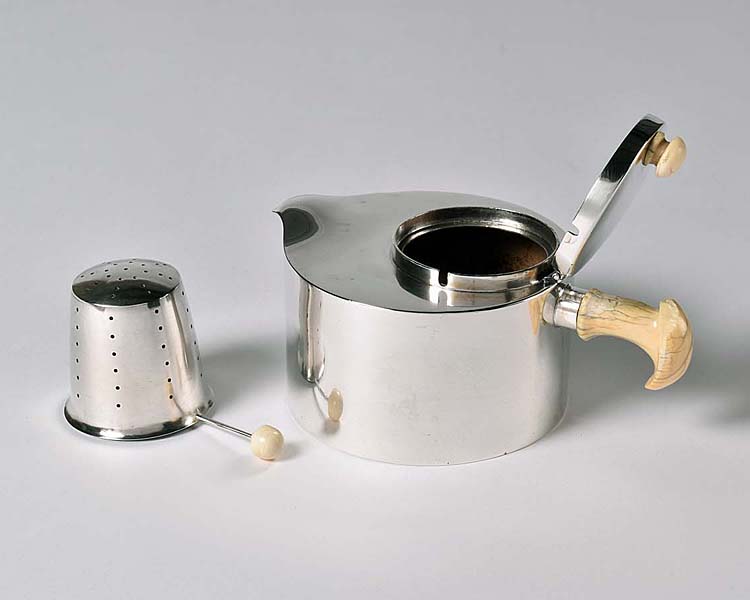
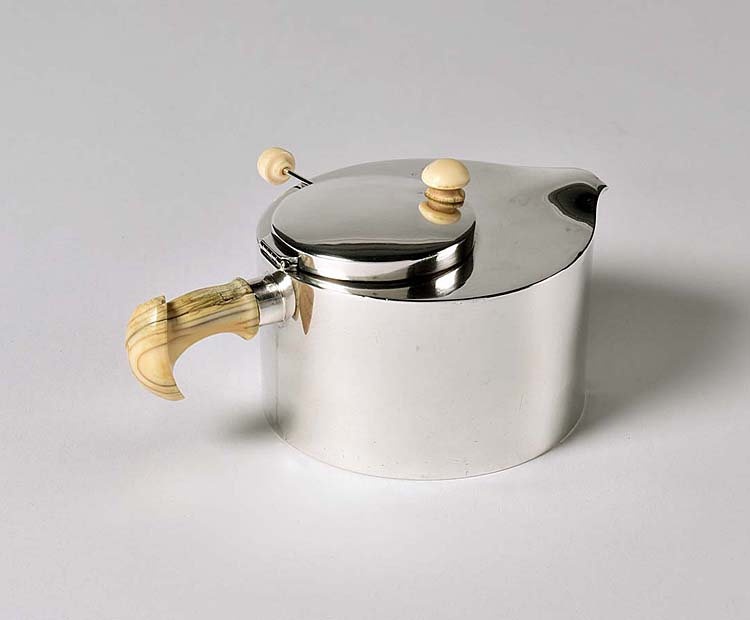
Emmy Roth (German, 1885-1942), “Tea Infuser” c. 1927. Silver, ivory, 3.25 x 6.75 x 4.88 in. Kamm Collection 2007.147.4.
KAMM COLLECTION
Within the Kamm Collection, there is a rare tea infuser created by Roth around 1927. This design, which is probably her most famous, has a simple silver cylindrical body with a flat hinged lid and a small protruding spout. However, what really seems to distinguish this piece is the use of carved ivory on the vessel’s finial, the knob on the strainer, and the infuser’s hook-like handle. A version of this infuser was exhibited at the 1927 Europäisches Kunstgewerbe at the Leipzig Grassi Museum in Leipzig, Germany. It was shown alongside Marianne Brandt’s MT-49 infuser and works by Wilhelm Wagenfeld and Marguerite Friedländer-Wildenhain. This example in the Kamm Collection was initially acquired by a collector right after this exhibition.
Roth, who “[emerged] from the apprentice and Werkbund traditions,” valued “harmony, the effect of light and shadow through the hammer blows, deliberate tautness, and simplicity.”[xvi] However, as she matured as an artist, she above all stressed the importance of functionality and practicality.[xvii] When developing ideas, Roth made sure that every element was “well thought out” and that “all conditions of usability [were] met.”[xviii] For instance, it was imperative that this infuser’s carved ivory handle was ergonomically designed.[xix] Roth would have considered the shape, size, material, and of course how the handle contributed to the ease of use. Furthermore, the inclusion of this organic element produced an eye-catching dichotomy when paired with the clean modern form. Collectively it presents as a “well-poised and beautiful utilitarian design” that ultimately serves as a lasting testament to Roth’s ingenuity.[xx]
Further Reading:
Duncan, Alastair. Modernism: Modernist Design 1880-1940. Minneapolis, Minnesota: Norwest Corporation, 1998.
Grosskopf, Anna and Tobias Hoffmann, eds. Watch! Women’s Art & Design 1880-1940. Germany: Hirmer/Brӧhan-Museum, 2022.
Sänger, Reinhard W. Women’s Silver. Paula Straus, Emmy Roth & Co. Silversmiths of the Bauhaus Period. Karlsruhe, Germany: Badisches Landesmuseum, 2011.
Notes: