
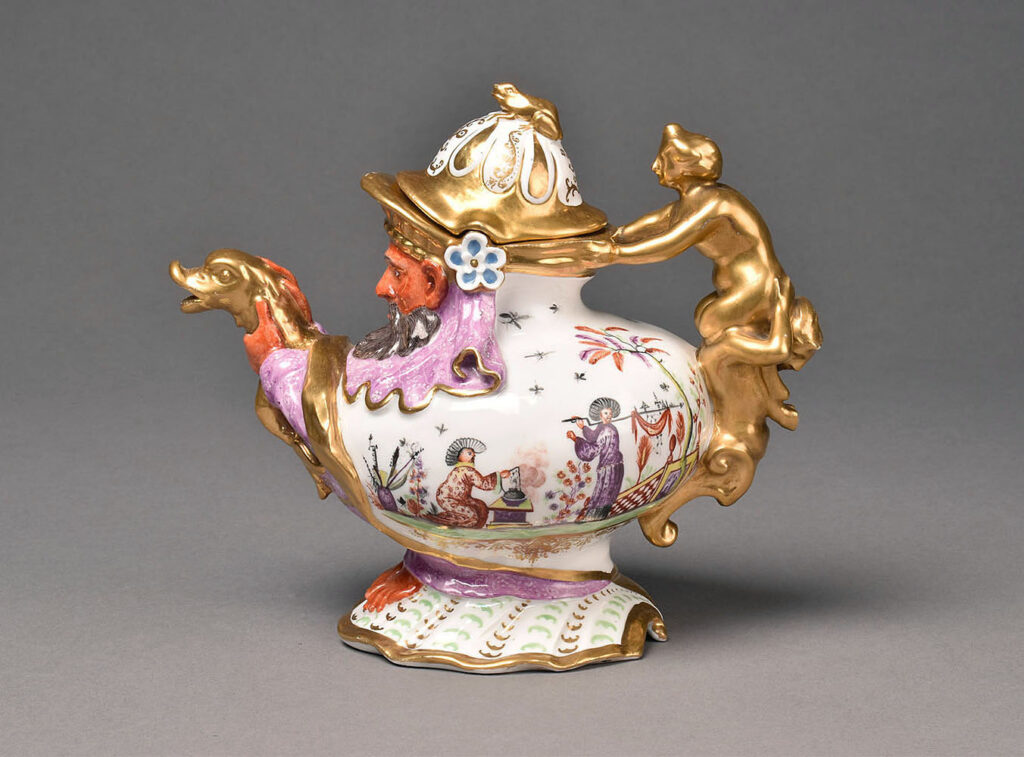
Within the Kamm Collection there is a grotesque porcelain teapot that could be considered “one of the most distinctive models produced at the Meissen factory.”[i] This vessel, which was first mentioned in the company’s records in 1719, is sometimes called a Wassermann (Water Man) Teapot or, in some cases, a magot teapot since it features a stylized seated Chinese figure.[ii] This particular example is incredibly rare, and it holds a position of prominence with the Kamm Collection. [iii]
Meissen Porcelain
When Europeans were introduced to Chinese hard paste porcelain, or true porcelain, in the fourteenth century, they were mesmerized by the material’s beauty, translucency, delicacy, and durability.[iv] However, the recipe needed to create this “magical” material was a mystery.[v] This meant that these luxury wares had to be imported from the East or, in some instances, potteries developed a version of hard paste called soft paste.[vi] This all changed in 1708 when the formula was finally unlocked.[vii] This feat was accomplished by Johann Friedrich Bӧttger and the mathematician and physicist Ehrenfried Walther von Tschirnhaus. Essentially, they combined a mixture of kaolin (china clay) with gypsum (alabaster, or hydrated calcium sulfate) which was then fired at a temperature of 1350 to 1400 degrees centigrade.[viii] This generated “the translucency and strength found in the much-coveted pieces from Asia.”[ix]
Bӧttger, who usually receives most of the credit for the formula, made this breakthrough while being held prisoner by Saxony’s elector Augustus the Strong.[x] Augustus captured him after hearing rumors that the alchemist had uncovered the secret of making gold also known as the philosopher’s stone.[xi] In truth, these rumors were just “boasts” from a “swaggering” young man.[xii] Nonetheless, Bӧttger was held captive at several locations including Albrechtsburg Castle in Meissen, Germany and the Goldhaus, a specially equipped metallurgical laboratory in nearby Dresden. During his over ten-year imprisonment, he “experimented desperately.”[xiii] His endeavors, of course, never produced gold, but his discovery of hard paste porcelain or “white gold,” as it is often called, ultimately saved him from execution.[xiv] Augustus established the Meissen factory at the Albrechtsburg Castle in 1710.[xv] It was Europe’s first true porcelain manufactory.
Kamm Collection
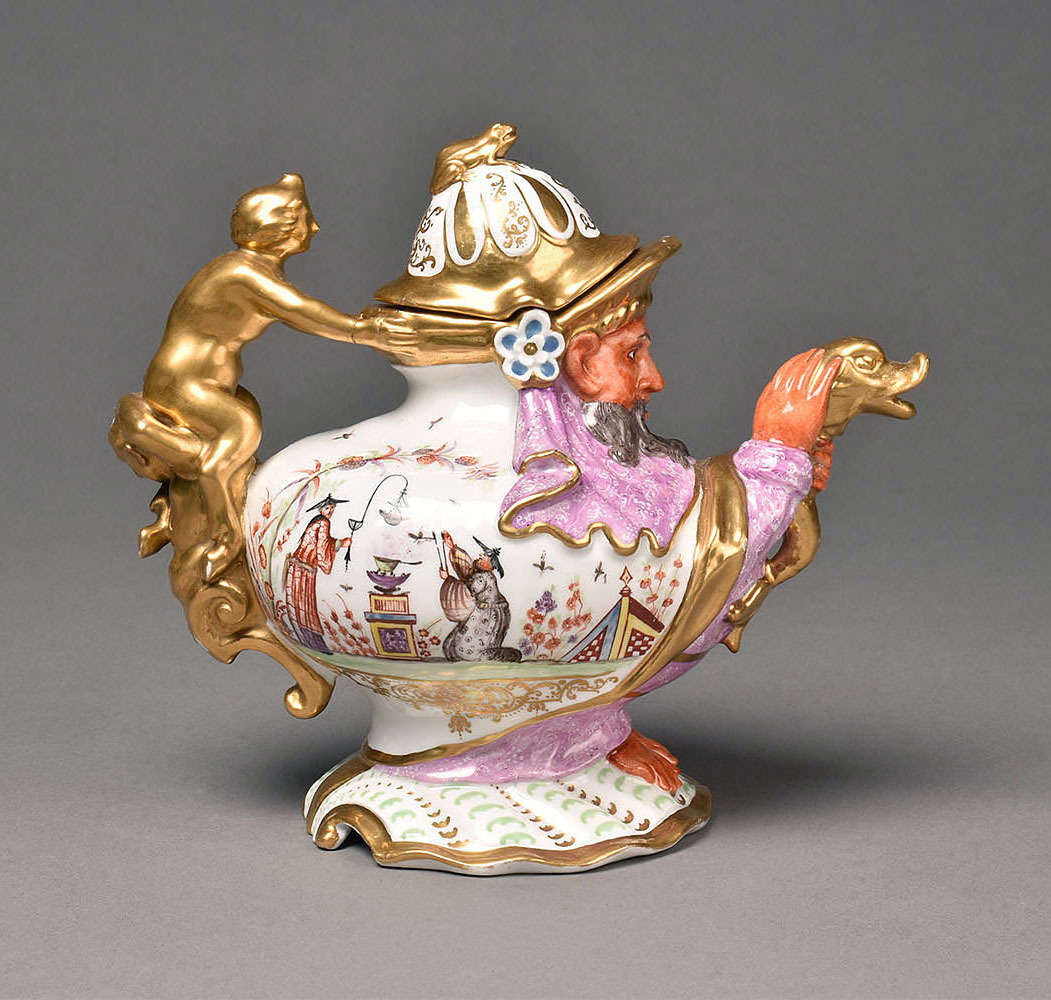
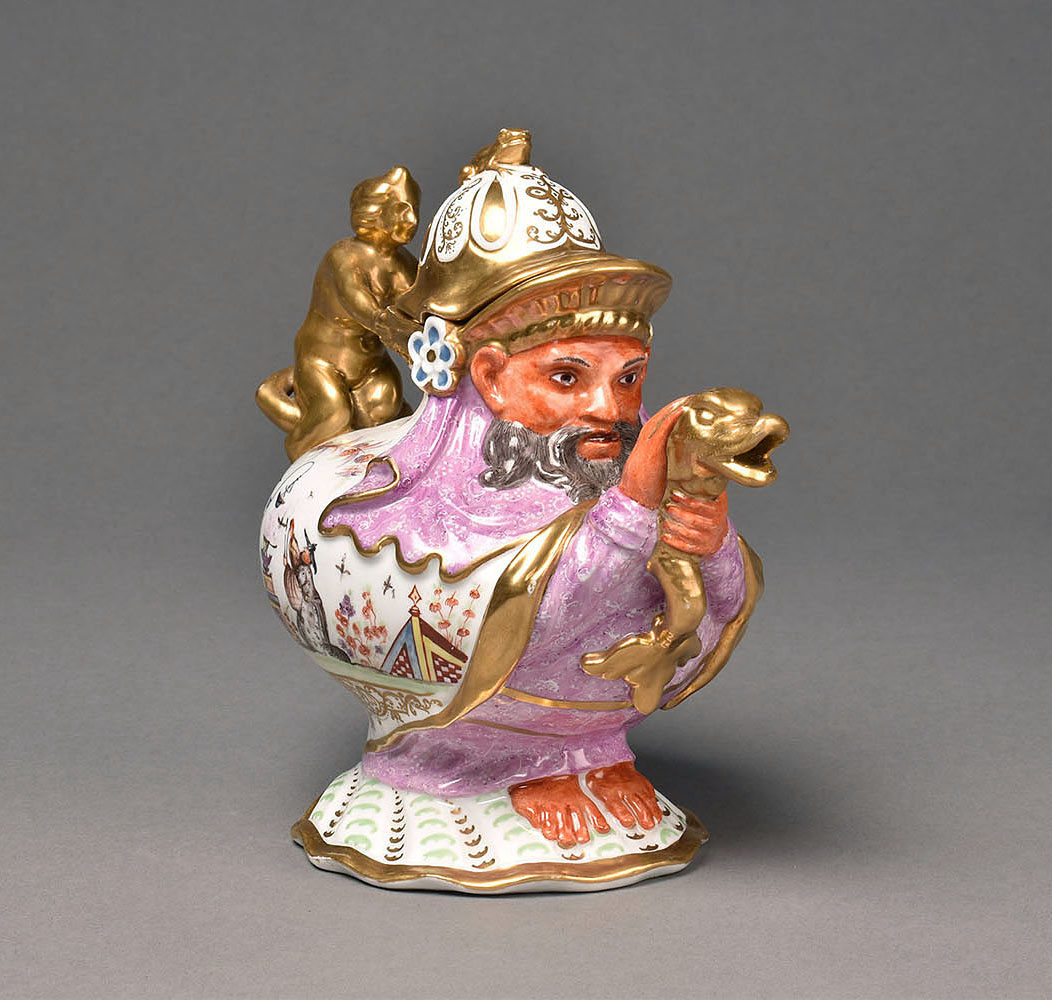
The Meissen Wassermann Teapot in the Kamm Collection features a bearded man with orange-colored flesh tones.[xvi] The man, who appears to be wearing a purple cloak that wraps around him, squats on a shell. Essentially, his body forms the body of the teapot and the gold and white helmet on his head is the lid. In his hands he holds the vessel’s spout, which is in the shape of a fish or a dolphin. Both the teapot’s spout and handle are covered in gold, but the handle contains completely different subject matter. The upper part of the handle is a female satyr. She is being supported by an atlantid hemi-figure who seems to hold her on his shoulders. Furthermore, there are chinoiserie scenes on each side of the teapot’s body and, a small frog acts as the vessel’s finial.
Overall, this model is “far more sculptural than any other teapot produced at the factory” and stylistically, this form is probably “the most Baroque item created by the [company].”[xvii] Scholars believe that the Dresden court goldsmith, Johann Jacob Irminger created this distinctive design since he was the “primary supplier of models” at that time.[xviii] However, George Fritzsche or Johann Gottlieb Kirchner could also be responsible.[xix] All three men were in fact active at Meissen during the proposed dates of creation. Inspiration for this form is more certain. The work was undoubtedly influenced by the French artist Jacques Stella. Stella’s prints as well as his designs in the publication Livre des Vases (1667) display striking similarities.[xx] One example even contains a grotesque bearded man wearing a helmet.
When it came to surface decoration, many of these Meissen teapots were finished outside of the factory and this example in the Kamm Collection is no different. For this reason, this vessel is often identified as a hausmaler teapot. Hausmaler essentially means an independent decorator was utilized.[xxi] In this case, evidence suggests that the work was completed at the family-run workshop of goldsmith Johann Aufenwerth. Located in Augsburg, Germany, this shop was known for its “distinctive style of decoration in which chinoiserie scenes are usually accompanied by prominent gilt designs.”[xxii] More specifically, the teapot in the Kamm Collection appears to be executed by Johann’s daughter Anna Elisabeth Wald (née Aufenwerth). The Aufenwerth workshop may not have “painted at the level of the…best Meissen factory painters,” but “the spontaneity that characterizes their work coupled with the rich and extensive gilding” made them “one of the most successful” independent decorators at that time.[xxiii]
Wassermann Teapots can have varying modeling and decoration. The Metropolitan Museum of Art in New York and the Museum of Fine Arts, Boston have versions that are certainly akin to this early example in the Kamm Collection.
Further Reading/Viewing:
Marchand, Suzanne L. Porcelain: A History from the Heart of Europe. Princeton, NJ: Princeton University Press, 2020.
Munger, Jeffrey H. European Porcelain in the Metropolitan Museum of Art. New York: Metropolitan Museum of Art, 2018.
Santangelo, Maria. A Princely Pursuit: the Malcolm D. Gutter Collection of Early Meissen Porcelain. San Francisco, CA: Fine Arts Museums of San Francisco in association with Hirmer Publishers, 2018.
Notes: