
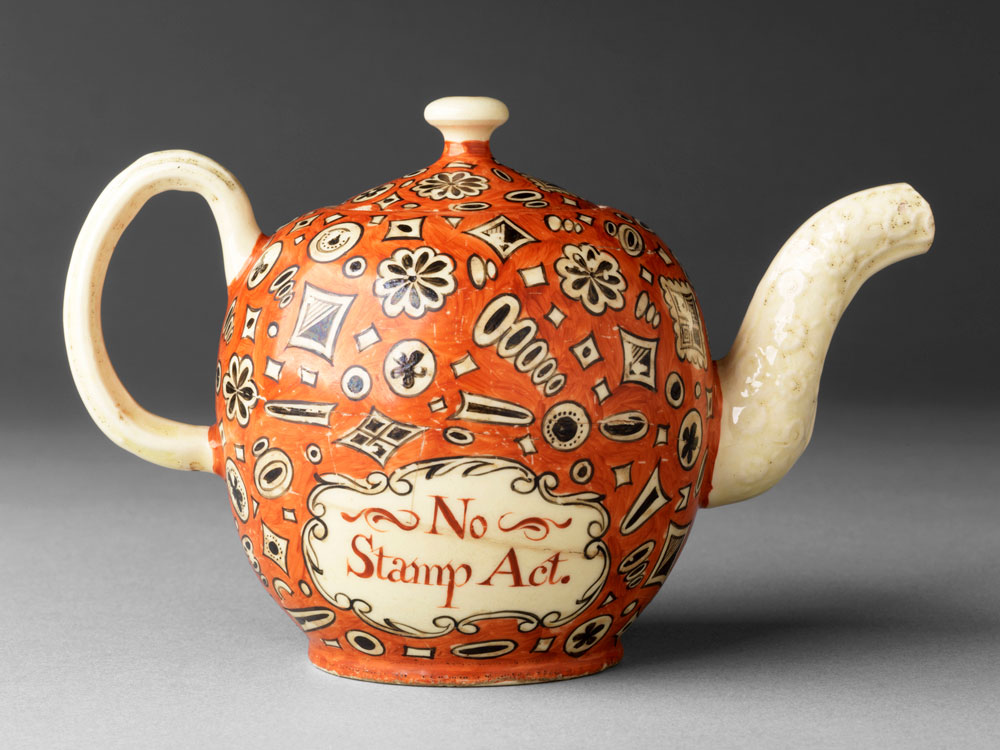
Early in 2009 a man brought a box of items from his mother’s house to an auctioneer in England for assessment. As the box was searched, an expert on eighteenth century pottery spotted a diminutive teapot among the bric-a-brac. The family who owned this vessel thought it to be of little to no value. However, they were mistaken. This rare object, called a “No Stamp Act” teapot, is incredibly significant. Very few of these forms have survived to present day. Furthermore, this example, which now resides in the Kamm Collection, appears to be the only known design of its kind in existence. Made in Staffordshire around 1766, this creamware vessel speaks volumes about an important moment in both American and English history.
The Stamp Act
The Stamp Act was passed by the British Parliament on March 22, 1765.[i] It required residents in England’s thirteen American colonies to pay a tax on all printed materials such as newspapers, books, pamphlets, and even playing cards.[ii] The act, which was instituted without the approval of the colonial legislatures, was initiated to help pay for troops stationed in the colonies during the Seven Years’ War. Americans reacted to this new tax with swift condemnation. In protest “they swore off British goods, burned effigies of stamp collectors, and forced distributors to resign from their posts until the duties were repealed.”[iii] Ultimately, these demonstrations inspired the rallying cry “no taxation without representation,” and, helped “[shape] the political landscape in the United States.”[iv] The British would repeal the Stamp Act by March of 1766, but the repercussions of their actions endured, and the stage was set for the American Revolution.
It is important to remember, especially since the focus here is on a teapot, that tea played a significant role in the Revolution. Following the Stamp Act Crisis, “[tea] provoked widespread colonial boycotts and when the Sons of Liberty finally dumped tea in the Boston Harbor, it kindled the fire of independence.”[v] The colonists felt that “to reject tea as a consumer item was to reject Great Britain as master of the American economy and government.”[vi] In essence, at that moment in history, tea, along with the “teapots, teacups, and the silverware that accompanied them, were representative of the clashes between imperialism and commercialism in the Atlantic world.”[vii]
Kamm Collection
The “No Stamp Act” teapot in the Kamm Collection is globular in shape with a slight, recessed, rimmed foot. Its body is covered in a one-of-a-kind, almost modern-looking pattern which contains cream and black-colored shapes floating on an orange background.[viii] Other elements, however, are just left cream such as its simple looping handle and knob finial. The teapot’s curved spout is also cream but features a low-relief floral design. On the lower portion of the vessel’s body, there are two opposing cartouches with inscriptions. One says, “No Stamp Act” and the other says, “Success to Trade in America.”[ix] This vessel, which only holds one cup of tea, was perhaps made by acclaimed potter and entrepreneur Josiah Wedgwood. However, in truth, the maker of this creamware teapot cannot be confirmed.

Creamware was an earthenware made from white clay with a lead glaze. It could range in color from ivory to light cream or straw. The first examples were produced in England in the 1740s, but these wares truly reached their peak popularity during the second half of the eighteenth century with the help of Wedgwood.[x] Essentially creamware was an affordable alternative to porcelain. Not only could it be made more easily with less expense, but this type of earthenware was also versatile. Creamware was utilized to create highly decorative, ornamental household items as well as more utilitarian pieces.[xi] It was an especially favorable choice for tea and tableware in England and the British colonies.
Scholars believe that “No Stamp Act” teapots were made in England for the American market. These forms proudly commemorated the reversal of that legislative decision. However, this victory was not only celebrated by the colonists. Many British citizens sympathized with the Americans on this issue, particularly the English potteries who had become “dependent on overseas consumers.”[xii] By the late eighteenth century the potteries in England had successfully “[forced] out much of the competition in the American market.”[xiii] In essence, the Stamp Act directly affected their business and from their perspective “economic benefits could trump political allegiances.”[xiv] A repeal meant trade could resume with the colonies without obstruction. This perhaps provides greater meaning to the statement “Success to Trade in America” written on the vessel in the Kamm Collection.
Interestingly, British potteries frequently utilized the first part of this refrain in the eighteenth century. For instance, English Delftware employed the phrase “Success to” on many objects. This was used when honoring a specific maritime triumph or even, in some rare cases, to toast a particular individual. In other words, a plate or bowl might bear the inscription, “Success to the Endeavor” or “Success to Roger Harrisson.”[xv] At the British Museum in London there is one example that must be mentioned. It is a Delftware bowl dated 1765 that states, “Success to Trade no Stamps.” Without a doubt, this wording is strikingly similar to the text on the teapot in the Kamm Collection.
Ultimately, this messaging would directly reflect one’s “personal beliefs, social constructions, and aesthetic tastes.”[xvi] The people who would have acquired these “No Stamp Act” teapots most likely wanted them “to be seen, read, interpreted, and debated within social settings.”[xvii] The Kamm Collection’s example seems to have never made it across the pond, but we can imagine that its original owner identified with the colonist’s plight and agreed with the viewpoint that was being communicated. Other surviving “No Stamp Act” teapots are similar in nature. For instance, an example in the Smithsonian’s American History Museum bears the inscriptions, “No Stamp Act” and on the reverse side, “America, Liberty Restored.”
This year is the 250th anniversary of the American Revolution. To honor this occasion the Museum of the City of New York, in partnership with The Gotham Center for New York City History, has organized an exhibition entitled, The Occupied City: New York and the American Revolution. The Kamm Collection’s “No Stamp Act” teapot will be featured in this exhibit among a “dynamic mix of historical objects, interactive media, and immersive environments.”[xviii] The Occupied City will be on view May 1, 2026 – August 22, 2027.
Further Reading/Viewing:
Mercantini, Jonathan. The Stamp Act of 1765: A History in Documents. Ontario, Canada: Broadview Press, 2017.
Merritt, Jane T. The Trouble with Tea: The Politics of Consumption in the Eighteenth-Century Global Economy. Baltimore, MD: John Hopkins University Press, 2017.
Morgan, Edmund S. and Helen M. Morgan. The Stamp Act Crisis: Prologue to Revolution. Chapel Hill: University of North Carolina Press for the Early American History and Culture, 1953.
Notes: