
The American silversmith Porter Blanchard (1886-1973) was a “great hammersmith” who valued “quality materials, sound craftsmanship, and honest, unpretentious design.”[i] Over the course of his career, he produced holloware and flatware in large quantities. These works, which were primarily made by hand utilizing traditional time-honored practices, embraced both early American and modern styles. The common thread was his penchant for “simpler, finer lines and plainer surfaces.”[ii] The Kamm Collection has three sterling silver services made by Blanchard. Each was created around 1930. For this blog post we will take a closer look at Blanchard’s work and what helped inspire his aesthetic principles.
Blanchard Silversmithing
Blanchard was born into a family of silversmiths that had been active since 1788 in colonial New England. Over the years each generation passed down their tools, techniques, and the secrets of their trade to the next generation. Blanchard’s father, George Porter, had a shop in Gardner, Massachusetts where he made flatware inspired by early American designs. It was in this setting that the younger Blanchard learned the intricacies of the craft and by 1914 he was running that business. This arrangement lasted until 1923, at which time Blanchard decided to move to California.[iii]
Many Americans were relocating to the Golden State during this period. Interestingly, California was being promoted throughout the country as this “Land-of-Oz” like place where the sun always shines.[iv] After arriving, Blanchard first established himself in Burbank, but later he opened shops in Hollywood and Pacoima. Initially he would describe himself as merely a “spoon maker,” but soon he was specializing in creating “high grade” handmade flatware and holloware.[v]
Over the next fifty years Blanchard would successfully adapt to the changing times.[vi] His business would particularly flourish in the 1920s. At one point Blanchard had at least twenty-five men working for him at his Burbank location. Flatware and holloware were sold at several shops and studios in Los Angeles as well as galleries in other cities. Blanchard also cleverly reached new clientele by selectively marketing his work to department stores throughout the country. Additionally, from his California studio, he catered to the Hollywood elite who had the money to purchase his creations.[vii] This proved to be a good decision, especially during the hard years of the Depression. In essence, Blanchard became a “silversmith to the stars.”[viii] Clients included such heavy weights as Cary Grant, Joan Crawford, and Cecil B. DeMille. Blanchard would remain “an active and practicing silversmith” until his death.[ix] While he made many astute business decisions during his lifetime; profitability was not what ultimately motivated him. Two years before Blanchard’s passing, he stated, “I follow the old school [of] craftsmanship that says a worker creates beauty for beauty’s sake, without financial gain as the chief goal.”[x]
Kamm Collection
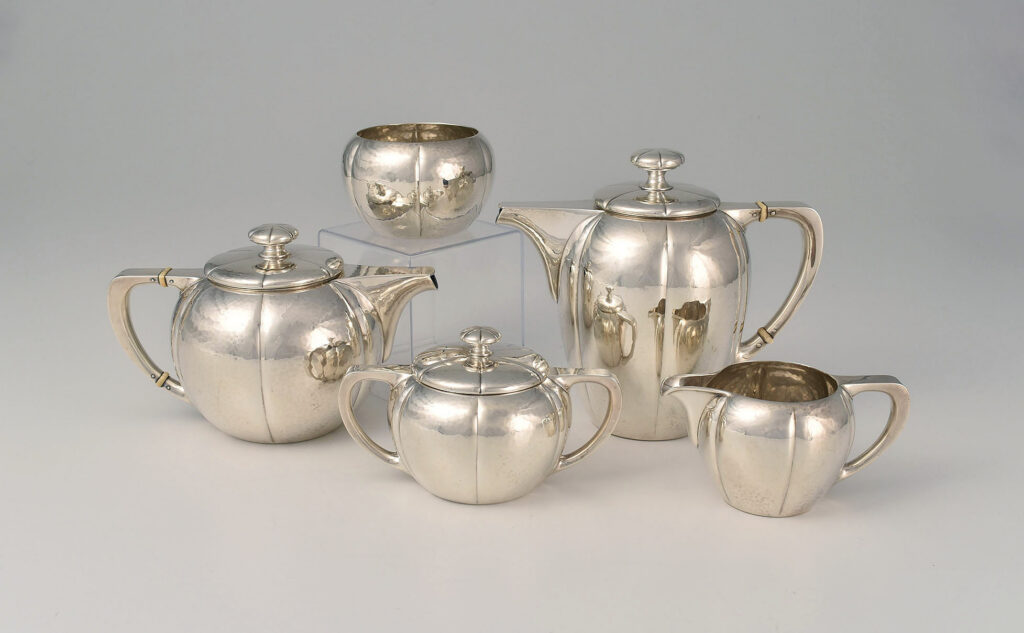
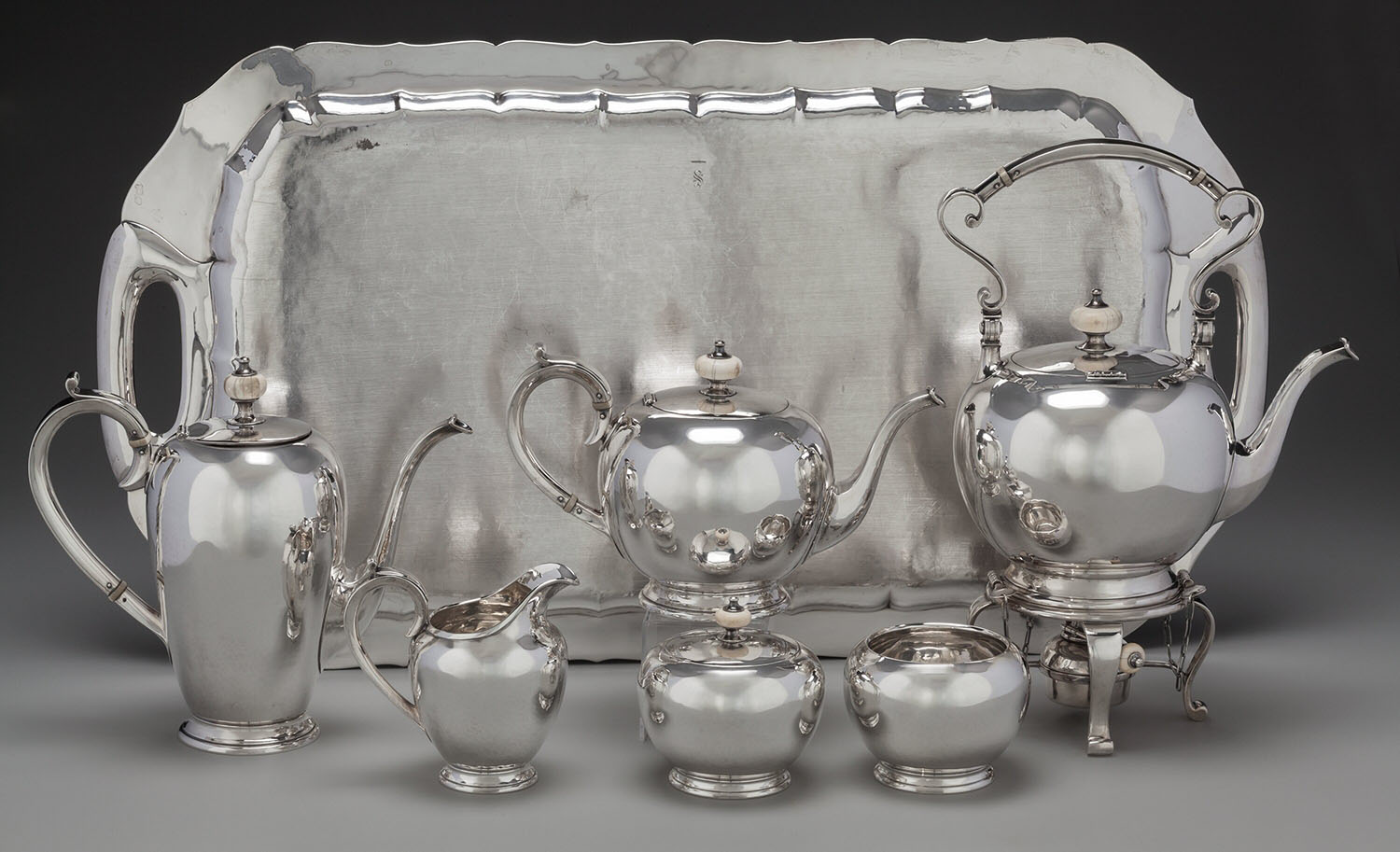
The three services in the Kamm Collection include a melon-shaped coffee and tea service, a Colonial Antique coffee and tea service, and a Bachelor’s Coffee Service. These works not only illustrate Blanchard’s enduring commitment to a “restrained, uncluttered aesthetic,” but also, they speak volumes about the inspiration behind that aesthetic.[xi]
Firstly, to better understand Blanchard’s approach to silversmithing it is important to recognize his commitment to the Arts and Crafts movement. From a young age, he was a member of the Arts and Crafts Society in Boston, and he was elected a Medalist, the society’s highest rank in 1944. After arriving in California, Blanchard would help organize the formation of an Arts and Crafts Society there and would become their first president. The Arts and Crafts movement, which originated in England in the late nineteenth-century, was “structured more by a set of ideals than a prescriptive style.”[xii] It “sought to improve standards of decorative design, believed to have been debased by mechanization, and to create environments in which beautiful and fine workmanship governed.”[xiii] Blanchard felt that careless workmanship concealed ornamentation. For this reason, he appreciated handmade works that were “simple, clean, and unadorned.”[xiv] In essence, if decoration did occur, it “was usually integral to the form” as seen on Blanchard’s melon-shaped tea and coffee service.[xv]
Another enduring influence for Blanchard was early American silversmithing styles. From those first days in his father’s shop, these historical examples were a valuable source of inspiration. Later, when he established his own studio in California, those eighteenth and nineteenth century works would continue to leave an impression. For example, Blanchard’s designs were assigned names such as Mayflower, Paul Revere, and, as seen in the Kamm Collection, Colonial Antique. He would advertise that these forms were “Old Silver Duplicated.”[xvi] However, in reality, these works were “derivative, not imitative.”[xvii] Blanchard utilized “an eighteenth-century design vocabulary of baluster shapes, gently domed lids, button finials, molded reel feet, and c-scroll handles, but in a strictly twentieth-century manner.”[xviii] Frequently, this meant stripping away embellishments such as chasing and engraving. These elements interfered with Blanchard’s desire to create simple honest forms.
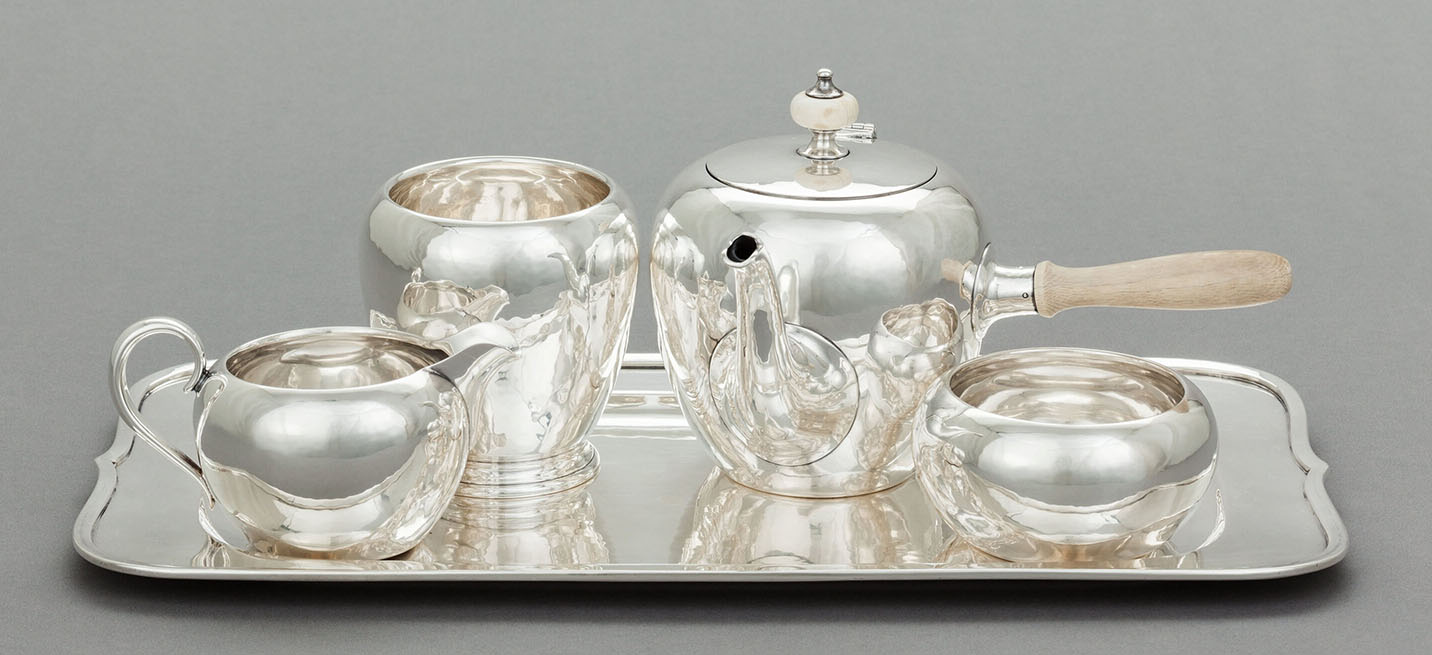
By 1930 Blanchard was “augmenting his colonial revival repertoire with more contemporary designs.”[xix] This shift could be the result of his interactions with some of “America’s leading proponents of European modernism.” [xx] In California Blanchard was surrounded by designers such as Kem Weber, Richard J. Neutra, and Jock Peters and this exposure was impactful. His initial response was the creation of the Commonwealth pattern (1930) which is credited for “bridging the arts and crafts and modern movements.”[xxi] Over time he began incorporating more modern components, such as cylindrical Bauhaus inspired shapes. This was an easy progression for Blanchard since he always embraced clean lines and a less decorated form. The Kamm Collection’s melon-shaped service and the Bachelor’s Coffee Service are from this period, and both seem to reflect some of these fresh modifications. The latter, however, is particularly modern in appearance. The Bachelor’s Coffee Service features simple ovoid shaped vessels with finely planished surfaces. The main decorative focal points are the coffeepot’s ivory finial and its straight white handle which extends from the vessel’s body.
Today Porter Blanchard’s work is included in numerous private and public collections such as the Los Angeles County Museum of Art and the Cooper Hewitt, Smithsonian Design Museum in New York City. Many of his papers, including photographs of his shop and technical design sketches, are available at the Archives of American Art in Washington, D.C.
Further Reading/Viewing:
Karlin, Elyse Zorn. Jewelry and Metalwork in the Arts and Crafts Tradition. Atglen, PA: Schiffer Publishing, Ltd., 1993.
Morse, Edgar W, ed. Silver in the Golden State. History Department of the Oakland Museum: Oakland, 1986.
Randy Stromsoe: Legacy of California Silversmithing. Craft in America. 2 April 2026.
Notes: