
Indigenous pueblo people in the American Southwest have been creating pottery for over a thousand years.[i] They gathered raw clay from the land and using hand-coiling methods created a variety of utilitarian forms often with carved or painted surfaces. Over time, individual pueblos developed their own styles and techniques which reflected their “deep-rooted cultural values and teachings.”[ii] This knowledge was “passed down through generations, often within families of highly skilled women potters.”[iii] For this reason, pueblo ceramics is probably “better understood as a dense web of relations between people, clay, ancestors, and place.”[iv]
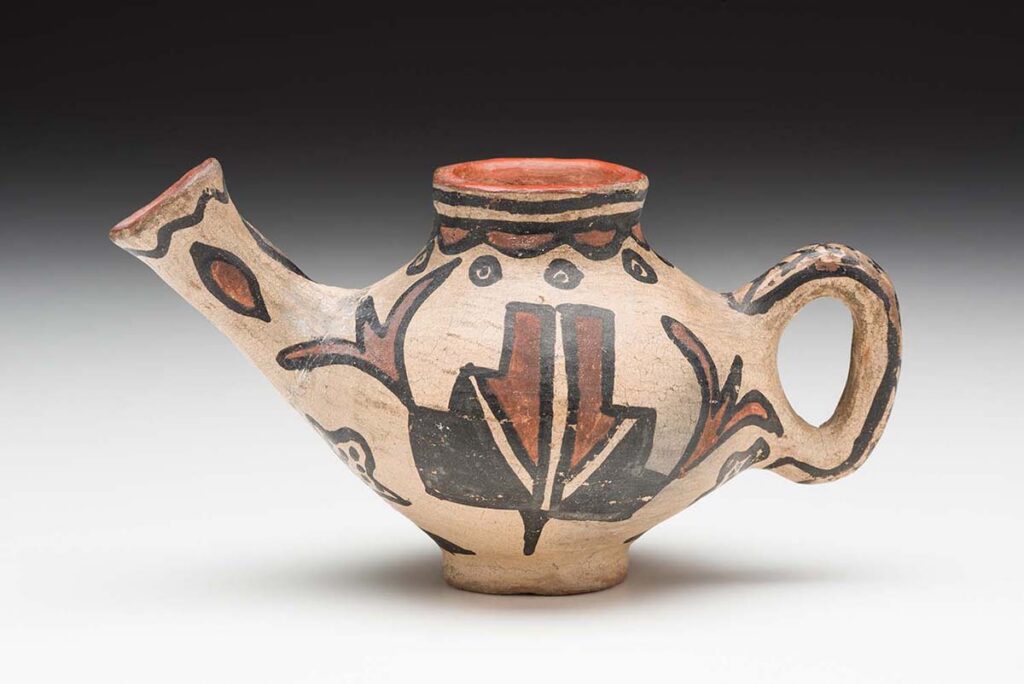
For this blog post, we will look at four incredibly rare teapots in the Kamm Collection. This group includes vessels from the San Ildefonso Pueblo, the Santo Domingo Pueblo (Kewa Pueblo), and two from the Hopi Pueblo.[v] One of these examples is attributed to Hopi-Tewa potter Nampeyo (also known as Iris Nampeyo) who is considered the matriarch of modern Hopi pottery.[vi]
A New Market
In the late nineteenth and early twentieth century, the pueblos experienced a rising number of travelers from the East. This uptick in visitors was the result of the railroad boom and a dramatic increase in highway construction as automobiles became the dominant mode of travel.[vii] Tourists as well as entrepreneurs, hoteliers, collectors, and anthropologists arrived in the Southwest, and their presence had an impact on the pueblo potters. For instance, their pottery, which had been reserved for domestic and ceremonial use, was now being actively collected by institutions such as the Smithsonian. What’s more, entrepreneurs, like Fred Harvey, were encouraging the potters to produce objects for curio shops and hotels such as the Hopi House in the Grand Canyon. The Fred Harvey Company even went so far as to provide Indian Detours. In this case, travelers were taken by automobile from their hotels to the pueblos, where they could purchase pottery and other crafts directly from the artists. In essence, during this period the pueblo potters had a new audience, and this audience influenced the function, design, and even the size of the objects they produced. Works were now being made to be sold which “[led] to new hybrid forms that balanced tradition with market demand.”[viii]
Teapots, which were probably introduced to the pueblo potters through anthropologists and traders, are a good example of this new hybrid.[ix] However, it appears these forms were only produced upon special request from trading posts.[x] This does not mean that pueblo people did not drink tea. They certainly did, but not in the “manner Anglo people consumed tea socially.”[xi] Instead, tea was reserved for medicinal purposes and typically consisted of dried stems, leaves, or flowers. These items would most likely be brewed in an open-mouthed, undecorated cooking jar and one would just ladle the liquid out of this jar to drink it.[xii]

Kamm Collection
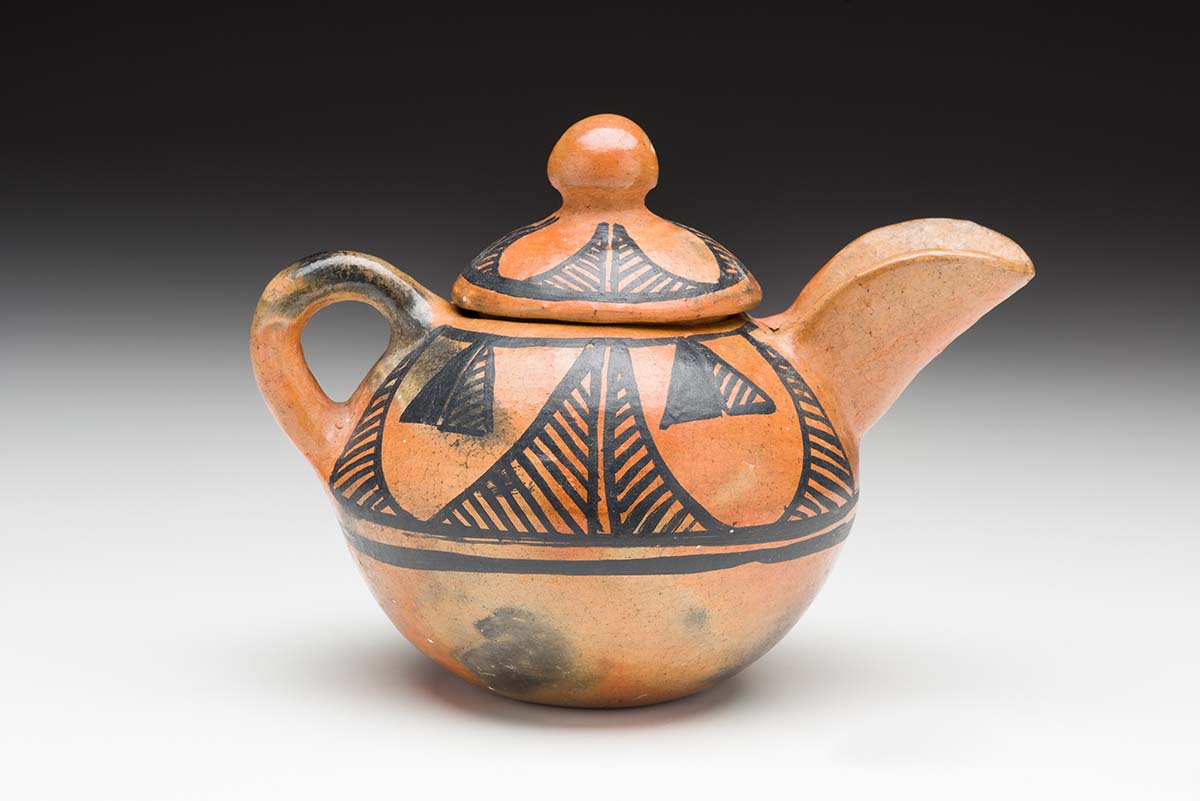
The four earthenware teapots in the Kamm Collection were made utilizing local clays, hand-built with coils, slip-painted, and then fired in a traditional earthen pit. Visually, for the most part, they all have similar rounded bodies as well as fairly simple spouts and handles. Only one example, a Hopi teapot (c.1920-1930), has a lid. Lids were an uncommon feature on pueblo pottery during this period. Not only was it difficult to make them fit properly when you consider their clay bodies and firing methods at the time, but lids could also fall off and be easily broken when transporting the teapots for sale.[xiii] Handles were challenging as well. However, pueblo pottery did include a variety of clay handles.
At first glance, the most noticeable characteristic of these teapots is how they each reflect the pottery traditions specific to their pueblo. For instance, the polychromatic San Ildefonso teapot (c.1890-1905) contains bold red and black surface designs set against a cream-colored ground. These designs are geometric and floral in nature, except for the cross-hatching pattern on the teapot’s looping handle. Stylistically these elements echo the work that San Ildefonso potters created for hundreds of years.[xiv] This is similarly seen on the Santo Domingo teapot (c.1930). Historically Santo Domingo pottery utilized cream or buff-colored clay known for its elasticity.[xv] These vessels were then decorated with a cream-colored slip with black (and sometimes red polychrome) designs. Interestingly, Santo Domingo potters also frequently paid special attention to the negative space giving their work a modern, abstract feeling. The example in the Kamm Collection contains all these qualities. Stylized bold floral patterns in a black slip cover the vessel’s cream-colored body and black slip is used to highlight elements such as its overarching handle. In addition, the teapot features a red slip interior which was often seen on Santo Domingo pots.
As you study these teapots more, you also get a sense of how much outside influences affected the work of pueblo potters. Traders and merchants, in particular, acted as guides steering the direction of production to meet market demands. They were behind the creation of the teapot forms themselves as well as the smaller stature of these vessels. This was preferred since large pieces of pottery were harder for tourists to transport back home. With this information in mind, one wonders what other design decisions were impacted by the traders or merchants. Take, for example, the previously mentioned Hopi teapot. This vessel, which is decorated with black slip on a sienna ground, features a duck-bill spout, a domed shaped lid, and a large ball finial. The lid and finial stand out as recognizable teapot components. Were these elements included in an effort to appeal to tourists who wanted to bring home a souvenir from the vanishing wild west?

The final teapot in this grouping is a vessel attributed to Nampeyo from around 1900.[xvi] The work is covered in white slip with red slip highlighting its unconventional pierced handle. Opposite the handle is a tubular spout with small holes at the end. These holes act as a strainer, which is a striking addition. On each side of the teapot’s body there are black geometric drawings. Both depict a multi-layered cross within a circle of black slip. “Motifs like [a] cross were not entirely foreign to pueblo people.”[xvii] Crosses were “part of a prehistoric painting vocabulary” and have been discovered on both wall paintings and pottery.[xviii]
Interestingly, the incorporation of these cross drawings gives us further insight into what is considered “Nampeyo’s forte.”[xix] She is known for creating innovative pottery based on ancient iconography and designs. This inspiration came from Hopi ancestral ceramics, especially the objects discovered at the archeological site of Sikyatki.[xx] In the last few decades of the nineteenth century Nampeyo would begin making Sikyatki Revival pieces based on the pottery that was unearthed there. These works were “an instant success” with traders who would turn around and sell these pots directly to the public or to firms such as the Fred Harvey Company.[xxi] By the beginning of the twentieth century Sikyatki Revival pottery “rapidly dominated the aesthetics of the Hopi and became publicly synonymous with the art of Nampeyo.”[xxii]
Further Reading/Viewing:
Dillingham, Rick, J.J. Brody, and Ellen Lehman. Fourteen Families in Pueblo Pottery. Albuquerque, New Mexico: University of New Mexico, 1994.
Indian Pueblo Cultural Center.
Kinsel, Rick. Grounded in Clay: The Spirit of Pueblo Pottery. London, England: Merrell Publishers, 2022.
Smithsonian Institution’s National Museum of the American Indian.
Wade, Edwin L. and Allan Cooke. Canvas of Clay: Seven Centuries of the Hopi Ceramic Art. Sedona, Arizona: El Otro Lado, 2012.
Notes: